Enterprise Mobility Management Market enables secure device, app, and data management while supporting productive remote and hybrid workforces.
ONTARIO, ONTARIO, CANADA, July 28, 2026 /EINPresswire.com/ — Enterprise Mobility Management has shifted from a discretionary IT convenience into a compliance-driven necessity, as organisations juggle sprawling fleets of smartphones, laptops, rugged handhelds, and connected sensors across increasingly hybrid workforces. EMM platforms unify device enrollment, application management, content governance, and mobile security policy within a single console, allowing IT and security teams to enforce consistent controls across iOS, Android, Windows, ChromeOS, and Linux endpoints without juggling separate point tools.
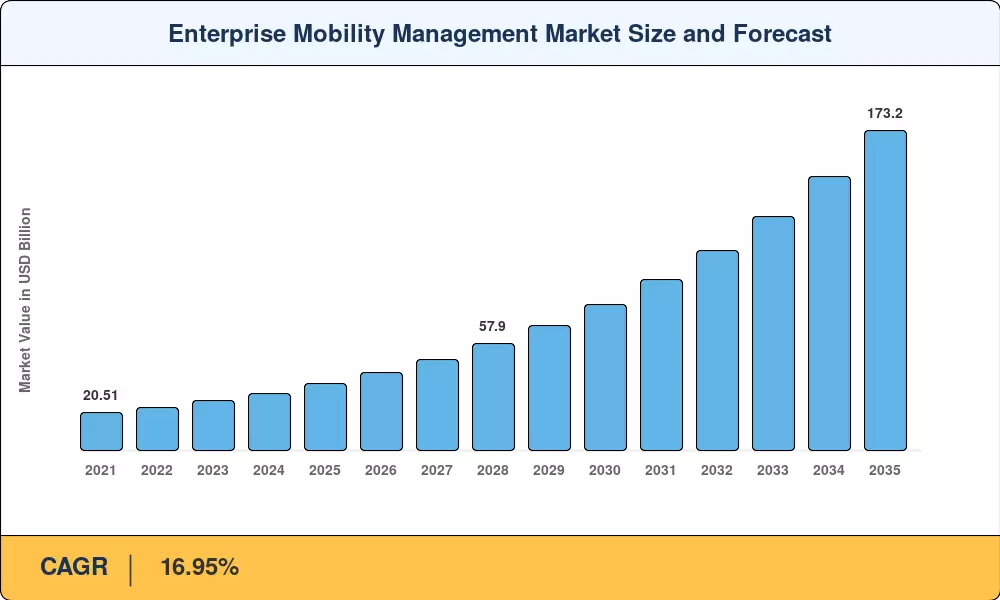
The Enterprise Mobility Management Market was valued at approximately USD 36.20 Billion in 2025 and is projected to climb from about USD 42.34 Billion in 2026 to roughly USD 173.20 Billion by 2035, reflecting a CAGR of 16.95% across the forecast period. Two regulatory catalysts are pulling spending forward: the U.S. federal push toward zero-trust architecture across civilian agencies, and Europe’s NIS2 Directive, which extended breach-notification and endpoint-hardening obligations to well over 100,000 entities. Together, these mandates have converted what was once optional IT spending into a compliance line item that enterprises can no longer defer.
The market’s technology centre of gravity is also shifting. Enterprises are retiring fragmented point solutions, standalone device-management agents, siloed application wrappers, and ageing VPN concentrators in favour of converged platforms that manage device, application, identity, and content policy from one console. That consolidation trend has already attracted several billion dollars in venture and private equity funding in recent years, as vendors race to build unified suites that IT buyers increasingly demand.
Get a Sample PDF of the Report at –
https://www.marketresearchfuture.com/sample_request/16209
Market Dynamics: Drivers, Restraints and Opportunities
Zero-trust security mandates are among the strongest forces propelling the Enterprise Mobility Management Market forward. Federal directives requiring advanced maturity across identity, device, network, application, and data pillars have created a procurement cascade that now extends well beyond government IT teams into prime contractors and the broader defence-industrial supply base. Parallel to this, the ongoing migration of workloads to the cloud is collapsing three- and four-vendor endpoint stacks into single-console platforms, trimming operating costs while improving how quickly organisations can respond to incidents. Bundling EMM capability into broader productivity suites has accelerated the displacement of standalone tools, with some major platforms adding tens of millions of new seats within just a couple of years.
Generative AI is reshaping how policies are written and enforced. AI copilots embedded in EMM consoles can now draft compliance policies, flag configuration drift, and pre-approve low-risk application requests largely without human intervention, a shift expected to let AI-augmented security operations resolve the majority of routine endpoint issues independently within the next few years. The rollout of 5G and edge computing is compounding this trend, moving device management from periodic check-ins to continuous, event-driven telemetry that shrinks incident-response windows from hours to seconds — a meaningful advantage given that the average cost of a data breach now runs into the millions of dollars.
Even so, the market faces real friction. Data-sovereignty rules across more than a hundred countries create conflicting obligations for multinational firms trying to run a single EMM tenant across jurisdictions, forcing vendors to build costly multi-region data-residency architectures. Integration complexity is another persistent restraint: large enterprises typically manage close to four distinct operating-system environments at once, and binding legacy Android forks, proprietary industrial devices, and modern iOS or ChromeOS fleets into one policy framework can stretch deployment timelines well past nine months in industrial settings. A well-documented global shortage of skilled cybersecurity talent running into the millions of unfilled roles further limits how quickly organizations, especially in South America and the Middle East, can staff and operate these platforms.
These constraints are also opening substantial opportunities. Vendors embedding large-language-model reasoning directly into their consoles are enabling natural-language policy creation and predictive vulnerability scoring, with early adopters already reporting sizable reductions in policy-creation time. Managed mobility services aimed at small and mid-sized enterprises in emerging markets represent another greenfield opportunity, particularly across Sub-Saharan Africa and Southeast Asia, where mobile internet penetration is high, but EMM adoption remains in the single digits. The rapid proliferation of connected industrial sensors, rugged handhelds, and wearables is also set to triple the addressable device count per organization by the end of the decade, and government agencies increasingly requiring sovereign-cloud infrastructure are creating a distinct market for locally hosted, nationally compliant EMM platforms.
Key Players and Competitive Insights
The Enterprise Mobility Management Market shows medium concentration, with the top five vendors together holding roughly half of global revenue and a long tail of specialists focused on rugged devices, Apple-only fleets, or regional sovereign clouds keeping the competitive landscape dynamic rather than tipping into oligopoly. Deep integration with broader identity and productivity ecosystems has become a defining competitive advantage, as buyers increasingly prefer bundled super-suites over standalone point products.
Leading companies in the global Enterprise Mobility Management Market include Microsoft, Broadcom (VMware), IBM, BlackBerry, Ivanti, Citrix, SOTI, Jamf, Samsung, and ManageEngine. Microsoft’s Intune ecosystem anchors the market through tight integration with Azure Active Directory and the Microsoft 365 suite, while Broadcom’s Workspace ONE platform emphasises multi-OS neutrality and workflow automation. IBM differentiates through AI-driven threat insights, BlackBerry and Ivanti lean on government-grade security certifications and patch-management depth, and specialists like SOTI and Jamf focus respectively on rugged/IoT device fleets and Apple-exclusive environments. Samsung’s Knox platform provides OEM-level firmware control that few competitors can match on its own hardware.
Buy this Premium Research Report at –
https://www.marketresearchfuture.com/checkout?currency=one_user-USD&report_id=16209
Market Segmentations
By Solution Type
• Mobile Device Management
• Mobile Application Management
• Mobile Content Management
• Mobile Security Management
By Deployment Mode
• Cloud-Based
• On-Premises
• Hybrid
By Enterprise Size
• Small Enterprises
• Medium Enterprises
• Large Enterprises
By Industry Vertical
• Healthcare
• Retail
• Government
• IT and Telecommunications
• Financial Services
• Manufacturing and Industrial
• Others
By Region
• North America
• Europe
• Asia-Pacific
• South America
• Middle East & Africa
Regional Insights
North America leads the Enterprise Mobility Management Market with roughly 35% of global revenue, anchored by stringent HIPAA, CMMC, and SEC breach-disclosure rules that keep enterprise security budgets elevated. The United States is the single largest national market, with federal civilian and defense agencies acting as anchor buyers under zero-trust procurement mandates, while Canada’s evolving privacy legislation is pushing mid-market firms to formalize endpoint governance for the first time.
Europe holds the second-largest share at approximately 27%, shaped by GDPR enforcement fines that have reached billions of euros cumulatively and the newly enforced NIS2 Directive, which extends mandatory endpoint-security obligations across critical-infrastructure operators and their supply chains. Germany’s manufacturing base is driving strong operational-technology endpoint enrollment, while France’s sovereign-cloud certification standard is fueling demand for locally hosted EMM instances.
Asia-Pacific is the fastest-growing region, expanding at roughly 23.6% CAGR through 2035 on the back of India’s Digital India programme, mobile-first banking expansion across Southeast Asia, and rapid 5G rollouts. China’s revenue leadership within the region reflects PIPL enforcement and large state-enterprise mobile fleets, while India’s growth is being fueled by its fast-expanding UPI-driven fintech ecosystem. South America and the Middle East & Africa remain smaller in absolute terms but are accelerating quickly, led by Brazil’s LGPD-driven banking-sector adoption and Saudi Arabia’s Vision 2030 smart-city buildout.
Browse A Full Report: (Including Full TOC, List Of Tables & Figures, and Chart) –
https://www.marketresearchfuture.com/reports/enterprise-mobility-management-market-16209
Recent Developments
Vendors have been racing to deepen platform capability and consolidate their footprints. Microsoft rolled out new Intune Suite add-ons, including endpoint privilege management and cloud-based public key infrastructure, expanding conditional-access granularity for hybrid device estates. Broadcom completed the integration of VMware’s Workspace ONE into its software portfolio, moving pricing to a simplified per-endpoint subscription model aimed at mid-market expansion. IBM has woven generative-AI policy recommendations directly into its MaaS360 console to speed compliance remediation.
On the regulatory side, U.S. federal agencies have been implementing an updated zero-trust maturity model that accelerates procurement of platforms capable of continuous device-posture assessment, while the European Commission’s enforcement of the NIS2 Directive has extended mandatory endpoint-security and incident-reporting obligations across critical-infrastructure operators. Samsung unveiled a cross-device trust architecture enabling synchronised security policies across its smartphone, tablet, and IoT portfolio, and SOTI added native Linux endpoint support to serve manufacturing and logistics customers deploying rugged terminals.
Frequently Asked Questions (FAQs)
Q1. What is the expected growth of the Enterprise Mobility Management Market?
The market is projected to grow at a CAGR of 16.95% from 2026 to 2035, reaching about USD 173.20 billion by 2035.
Q2. What factors are driving the Enterprise Mobility Management Market?
Zero-trust security mandates, cloud migration, AI-powered policy automation, and 5G-enabled edge management are major growth drivers.
Q3. Which region dominates the Enterprise Mobility Management Market?
North America currently holds the largest share, at roughly 35%, driven by stringent compliance mandates and large enterprise density.
Q4. What are the major challenges facing the market?
Data-sovereignty fragmentation, legacy-system integration complexity, and a global shortage of skilled cybersecurity talent remain key challenges.
Q5. Which deployment mode is growing the fastest?
Cloud-based deployment is expanding fastest, at roughly a 17.45% CAGR, as organisations migrate away from on-premise infrastructure.
Q6. Who are the leading companies in the Enterprise Mobility Management Market?
Major players include Microsoft, Broadcom (VMware), IBM, BlackBerry, Ivanti, Citrix, SOTI, Jamf, Samsung, and ManageEngine.
Q7. Which end-user industry is growing the fastest?
Healthcare and Life Sciences is the fastest-growing vertical, at roughly a 21.5% CAGR, driven by HIPAA multi-factor authentication mandates.
➤ Exclusive Research Publications by Market Research Future:
No Code Ai Platform Market –
https://www.marketresearchfuture.com/reports/no-code-ai-platform-market-11647
Communication Platform As A Service Market –
https://www.marketresearchfuture.com/reports/communication-platform-as-a-service-market-11689
Ai In Fintech Market –
https://www.marketresearchfuture.com/reports/ai-in-fintech-market-11756
Music Streaming Market –
https://www.marketresearchfuture.com/reports/music-streaming-market-12017
Autonomous Ai And Autonomous Agents Market –
https://www.marketresearchfuture.com/reports/autonomous-ai-autonomous-agents-market-12255
5G Demand And Services Market –
https://www.marketresearchfuture.com/reports/5g-demand-and-services-market-16099
Client Computing Market –
https://www.marketresearchfuture.com/reports/client-computing-market-16110
Data Collection And Labelling Market –
https://www.marketresearchfuture.com/reports/data-collection-and-labelling-market-16216
Us Managed Services Market –
https://www.marketresearchfuture.com/reports/united-states-managed-services-market-20716
Nosql Market –
https://www.marketresearchfuture.com/reports/nosql-market-21413
Sagar Kadam
Market Research Future
+ + +1 628-258-0071
email us here
Legal Disclaimer:
EIN Presswire provides this news content “as is” without warranty of any kind. We do not accept any responsibility or liability
for the accuracy, content, images, videos, licenses, completeness, legality, or reliability of the information contained in this
article. If you have any complaints or copyright issues related to this article, kindly contact the author above.

Media gallery